

A Technical Guide to Bearing Cup, Bearing Cone Matching, Replacement Selection, and Purchasing
Replacing a tapered roller bearing may seem simple: identify the old part number, find a replacement, and install it.
However, professional maintenance teams and bearing distributors know that cup and cone bearing replacement is not only a dimensional matching process.
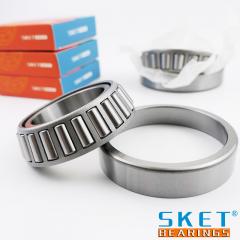
A tapered roller bearing consists of two precision-matched components:
- Bearing Cup – the outer ring installed in the housing
- Bearing Cone – the inner ring assembly mounted on the shaft
These components are designed together to achieve the correct:
- Roller contact pattern
- Internal clearance
- Load distribution
- Operating temperature
- Service life
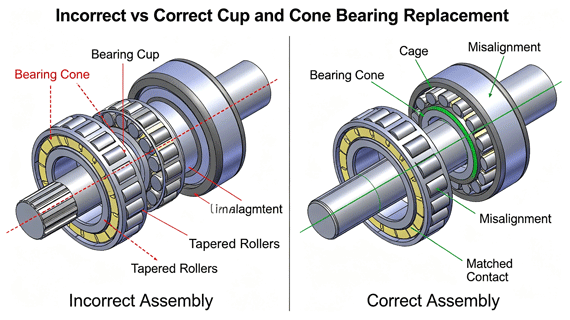
Using an incorrect combination, such as installing a new cone with a worn cup, can result in:
- Uneven roller contact
- Excessive friction
- Increased operating temperature
- Premature bearing failure
Real Failure Example: Why Cup and Cone Matching Matters
A heavy truck fleet experienced repeated wheel hub bearing failures after maintenance technicians replaced only the bearing cone while reusing the original bearing cup.
The result:
| Item | Before Replacement |
|---|---|
| Replacement method | New cone + used cup |
| Bearing service life | Less than 3 months |
| Operating temperature | 95°C under full load |
| Maintenance condition | Frequent unplanned downtime |
After replacing the bearing with a complete matched cup and cone set:
| Item | After Correct Replacement |
|---|---|
| Replacement method | New matched cup and cone assembly |
| Service life | More than 12 months |
| Operating temperature | Reduced to 62°C |
| Maintenance downtime | Reduced by 80% |
The root cause was not incorrect dimensions. The problem was that the worn cup changed the roller contact geometry, causing uneven load distribution.
This guide explains how engineers, distributors, and purchasing teams can correctly select a cup and cone bearing replacement solution while avoiding costly mistakes.

What Is a Cup and Cone Bearing?
A cup and cone bearing is the separable design structure commonly used in tapered roller bearings.
Unlike deep groove ball bearings, tapered roller bearings are designed to handle:
- High radial loads
- High axial loads
- Combined loading conditions
A complete tapered roller bearing consists of two main assemblies:
Bearing Cup
The bearing cup is the outer ring component.
It is normally installed inside the housing and provides:
- Outer raceway surface
- Roller guidance
- Load transfer into the housing
The cup is usually identified by its own part number.
Bearing Cone
The bearing cone is the inner assembly installed on the rotating shaft.
It contains:
- Inner ring
- Tapered rollers
- Cage
The cone transfers operating loads from the shaft through the rollers to the cup.
How Load Transfers Through a Cup and Cone Bearing
Shaft
 ↓
Bearing Cone
 ↓
Tapered Rollers
 ↓
Bearing Cup
 ↓
Housing
Because the cup and cone work together as a precision system, both components must maintain correct geometry.
Bearing Cup vs Cone: Why Matching Matters for Replacement Purchasing
A common mistake during maintenance is assuming:“If the dimensions match, the bearing components are interchangeable.”
This is not always correct.
The cup and cone are manufactured as a matched assembly with controlled:
- Raceway geometry
- Roller angle
- Contact pattern
- Internal clearance
A new cone installed with a worn cup may create:
- Edge loading
- Uneven pressure distribution
- Higher friction
- Increased heat generation
Recommended Replacement Practice
For most applications:Replace the bearing cup and cone together as a complete matched set.
Benefits:
- Correct roller contact
- Stable load distribution
- Reduced installation risk
- Longer service life
Cup and Cone Bearing Replacement: When Should Both Components Be Replaced?
One of the most common questions from maintenance teams is:Can I replace only the bearing cone?
In professional applications, replacing only one component is generally not recommended when the bearing has experienced significant operation.
Replace Both Cup and Cone When:
1. The Bearing Has Already Operated for a Long Period
A used cup may have:
- Raceway wear
- Surface fatigue
- Contact pattern changes
Even if the damage is not visible, the internal geometry may no longer match a new cone.
2. The Bearing Experienced Failure Conditions
Examples:
- Overloading
- Lubrication failure
- Contamination
- Overheating
These conditions can damage both components.
3. The Original Matching Information Is Unknown
For aftermarket replacement:
If the original cup and cone pairing cannot be confirmed, replacing the complete set reduces risk.
How to Identify the Correct Tapered Roller Bearing Replacement
Selecting a replacement tapered roller bearing requires several verification steps.
Step 1: Confirm the Original Bearing Number
Check markings on:
- Bearing cup
- Bearing cone
Record:
- Manufacturer code
- Series number
- Suffix information
If possible, take clear photos and provide them to your supplier.
Step 2: Verify Dimensions
Important dimensions include:
| Parameter | Why It Matters |
|---|---|
| Bore diameter | Shaft compatibility |
| Outside diameter | Housing fit |
| Total width | Assembly position |
| Cup width | Interchange accuracy |
| Cone width | Internal geometry |
| Dynamic load rating | Operating capacity |
| Static load rating | Shock resistance |
For detailed model comparison, refer to:Tapered Roller Bearing Size Chart and Selection Guide
Critical Technical Parameters Before Ordering
Professional buyers should verify more than just bearing dimensions.
Key Parameters
| Parameter | Why It Matters | Common Options |
|---|---|---|
| Precision Class | Determines running accuracy | P0, P6, P5, P4 |
| Internal Clearance | Controls operating condition | C0, C2, C3, C4 |
| Contact Angle | Determines radial and axial load distribution | 10°–16°, 25°–30° |
| Material Grade | Affects fatigue and impact resistance | 52100, 100Cr6, 8620 |
| Hardness | Influences wear resistance | HRC 58–62 |
| Cage Design | Affects speed and temperature capability | Steel, Brass, Polymer |
Understanding Contact Angle Selection
The contact angle determines how a tapered roller bearing distributes radial and axial loads.
Small Contact Angle
Typical range:
10°–16°
Characteristics:
- Higher radial load capability
- Moderate axial load capacity
Common applications:
- General industrial equipment
- Standard machinery
Large Contact Angle
Typical range:
25°–30°
Characteristics:
- Higher axial load capacity
- Better thrust resistance
Common applications:
- Truck wheel hubs
- Heavy-duty equipment
The actual contact angle depends on:
- Bearing series
- Manufacturer design
- Suffix code
For example:
- Some standard designs use approximately 10°50′ contact angles
- Heavy-duty designs may use 27°–30° contact angles
Always verify the original bearing specification before replacement.
Selecting the Correct Internal Clearance
Internal clearance affects:
- Operating temperature
- Thermal expansion
- Preload condition
- Bearing life
Clearance Selection Guide
| Operating Condition | Recommended Clearance |
|---|---|
| Normal temperature and standard fit | C0 |
| High temperature ≥100°C | C3 or C4 |
| Heavy interference fit | C3 |
| Precision spindle with controlled temperature rise | C2 (special application only) |
Important:
C2 clearance should not be selected simply because an application requires “high precision”.
For most applications such as:
- Truck wheel hubs
- Agricultural machinery
- Industrial gearboxes
C0 or C3 is commonly selected depending on operating conditions.
Bearing Material Selection
Material selection directly affects:
- Fatigue resistance
- Impact capability
- Operating reliability
Common Bearing Steel Options
| Material Category | GB | AISI/SAE | DIN | Application |
|---|---|---|---|---|
| Through-hardening bearing steel | GCr15 | 52100 | 100Cr6 | Standard fatigue load applications |
| Case-hardening steel | 20CrMo | 8620 | 20CrMo | Heavy impact and shock loads |
Through-Hardening Steel
Typical applications:
- Industrial machinery
- Standard tapered roller bearings
- General load conditions
Case-Hardening Steel
Advantages:
- Tough core
- Hard wear-resistant surface
- Better impact resistance
Suitable for:
- Truck hubs
- Construction equipment
- Heavy shock applications
For critical applications, buyers should request:
- Material certificates
- Heat treatment records
- Batch traceability
How to Verify Cup and Cone Bearing Interchange Compatibility
Finding a replacement is often more complicated than searching a similar bearing number.
Professional buyers should follow a three-step verification process.
Step 1: Check Original Marking
Confirm:
- Bearing number
- Manufacturer
- Suffix code
Recommended:
Provide:
- Photos of cup marking
- Photos of cone marking
Step 2: Compare Dimensions
Verify:
- Bore diameter
- Outside diameter
- Width
- Assembly height
- Contact angle
This is especially important for:
- Inch series bearings
- Imported equipment
- Aftermarket replacement parts
Step 3: Confirm Application Conditions
Provide:
- Rotation speed
- Radial load
- Axial load
- Operating temperature
- Shock conditions
A professional supplier should verify whether the replacement bearing matches the actual working environment.
For distributors comparing traditional tapered roller bearings and integrated hub units: See:Tapered Roller Bearings vs Hub Units for Trucks: A Complete Buying Guide for Distributors
Why Distributors Prefer Tapered Roller Bearing Cup and Cone Sets
Many distributors purchase:tapered roller bearing cup and cone sets
instead of individual components.
Advantages include:
Guaranteed Compatibility
The cup and cone are designed as a matched assembly.
Reduced Customer Complaints
Incorrect component combinations are avoided.
Easier Inventory Management
Complete sets simplify:
- Stock management
- Packaging
- Customer support
For aftermarket distributors, supplying complete sets improves reliability and customer satisfaction.
Common Replacement Mistakes
Mistake 1: Mixing New Cone With Old Cup
Risk:
- Uneven contact
- Higher temperature
- Reduced bearing life
Mistake 2: Selecting Only by Dimensions
Correct replacement requires checking:
- Load rating
- Contact angle
- Clearance
- Material
Mistake 3: Ignoring Bearing Preload
Incorrect preload may cause:
Excessive Preload
- Increased friction
- Temperature rise
- Premature failure
Insufficient Preload
- Excessive play
- Vibration
- Noise
Cup and Cone Bearing Supply Scope
Available solutions include:
| Category | Specification |
|---|---|
| Metric Series | 30200, 30300, 31300, 32200, 32300, 33100, 33200 |
| Inch Series | LM, HM, LL, M |
| Bore Diameter | 15mm–400mm |
| Precision Class | P0, P6, P5 |
| Clearance | C0, C2, C3, C4 |
| Standard Lead Time | 3–7 days |
| Custom Production | 15–30 days |
| MOQ | Flexible for standard sizes |
Support available:
- OEM replacement verification
- Cross reference checking
- Customized packaging
- Export documentation
How to Choose a Reliable Tapered Roller Bearing Supplier
International buyers should evaluate:
Quality Documentation
Confirm availability of:
- Inspection reports
- Material certificates
- Traceability records
Packaging Standards
For international shipping:
- Moisture protection
- Anti-corrosion packaging
- Export-safe cartons
Technical Support
A reliable supplier should support:
- Interchange verification
- Bearing selection
- Failure analysis
Need Help Selecting a Cup and Cone Bearing Replacement?
Choosing the correct replacement can be difficult when:
- The original number is unclear
- Equipment uses imported bearings
- Multiple interchange options exist
Technical support can help with:
Free Interchange Verification
Provide:
- Old bearing number
- Photos
- Dimensions
Receive:
- Replacement recommendation
Engineering Selection Support
Including:
- Clearance confirmation
- Contact angle verification
- Application review
Request Samples or Pricing
Available for:
- Standard sizes
- OEM replacement
- Distributor supply
Contact the technical team for replacement verification and purchasing support.
Frequently Asked Questions
Can I replace only the bearing cone?
In most applications, replacing the complete cup and cone set is recommended because both components are designed as a matched assembly.
Are cup and cone bearings interchangeable?
Some models have interchange equivalents, but compatibility must be verified through:
- Dimensions
- Load rating
- Contact angle
- Manufacturer references
What is a tapered roller bearing cup and cone set?
It is a complete matched assembly including:
- Bearing cup
- Bearing cone
- Rollers
- Cage
How do I find a replacement for an old tapered roller bearing?
Check the original marking, measure dimensions, and provide operating conditions to a bearing supplier for verification.
Conclusion
Selecting the correct cup and cone bearing replacement requires more than finding a similar size.
Professional buyers should verify:
- Cup and cone matching
- Contact angle
- Internal clearance
- Material grade
- Interchange compatibility
- Application conditions
For distributors, OEMs, and maintenance teams, choosing the correct tapered roller bearing cup and cone set reduces downtime, prevents premature failure, and improves long-term operating reliability.
A technically verified replacement is not only a bearing purchase—it is a reliability decision.